

Electoral Codes & Statutes
March 2026 edition
Standing Orders of the Congress of the NFF
Article 1
Representation and participation in the Congress
1
1 of the Statutes of the NFF.
Members of the NFF shall be represented at the Congress by the delegates as mentioned under art. 26 par.
2 Congress.
The names of the delegates shall be submitted to the general secretariat before the opening of the
3
the Congress. The Executive Committee shall issue appropriate directives in this connection.
The NFF shall bear the costs of travel and accommodation for the delegates of the Members taking part in
Article 2
Chairperson
1
2
The President of the NFF shall chair the Congress. If the President is unable to attend, the 1st vice-president shall deputise and if he is not present, the 2nd Vice-President shall deputise.
The chairperson shall ensure that the Congress is conducted in strict compliance with these Standing Orders, open and close the Congress and debates, and, unless the Congress decides otherwise, grant delegates permission to speak and conduct all discussions.
3
action against any delegate who disturbs the debates:
4
If an appeal is made against such action, the Congress shall decide immediately without debate.
The chairperson shall be responsible for maintaining order during debates. He may take the following
-
a) a call to order;
-
b) a reprimand;
-
c) exclusion from the Congress.
Article 3
Article 4
Article 5
Scrutineers
At the beginning of the meeting, the Congress shall appoint an adequate number of scrutineers to count the votes and to assist the General Secretary in distributing and counting voting papers issued for the elections.
Interpreters
Official interpreters shall be appointed to interpret into the official languages of the Congress. They shall be appointed by the general secretariat.
Debates
1
Debates on each item on the agenda shall be preceded by a short report or introduction:
4
-
a) by the chairperson or a member of the Executive Committee designated for this purpose;
-
b) by a representative of the committee designated by the Executive Committee to give such a report or introduction;
-
c) by a delegate of the Member that requested the item to be included in the agenda.
The chairperson then opens the debate.
Article 6 Speakers
Article 7
Proposals during the Congress
2
1
he has obtained permission to do so.
Permission to speak is granted in the order in which it is requested. A speaker may not begin speaking until
2
permission to speak have spoken.
3
A speaker may not speak for a second time on the same item until all other delegates who have requested The chairperson may set a time limit for speakers.
1
the subject under discussion shall not be admitted to the debate.
All proposals submitted during the Congress shall be made in writing. Proposals which are not relevant to
2
being put to the debate.
Any amendment to such initial proposals shall be drawn up in writing and passed to the chairperson before
Article 8
Procedural motions and closing of debates
-
1 If a procedural motion is made, discussion on the main question shall be suspended until a vote has been taken on the motion.
-
2 If a motion is made to close the discussion, it shall immediately be put to the vote without debate. If the motion is approved, permission to speak shall only be granted to those Members who asked to speak before the vote was taken.
-
3 The chairperson shall close the discussion unless the Congress decides otherwise by a majority (more than 50%) of the valid votes cast.
Article 9 Votes
1
unless decided otherwise by the Congress.
A decision that requires a vote shall be reached by a show of hands or by means of an electronic count,
5
-
2 Before each vote, the chairperson, or the person designated by him, shall read the text of the proposal aloud and explain the voting procedure (quorum) to the Congress. If an objection is raised, the Congress shall decide immediately.
-
3 Votes may be taken by roll call if requested by at least 20 delegates representing the Members present and eligible to vote.
4
-
5 Proposals made during the Congress shall be put to the vote in the order in which they are submitted. If there are more than two main proposals, they shall be put to the vote in succession and the delegates may not vote for more than one of the proposals.
-
6 Alterations to amendments shall be put to the vote before the amendments proper, and amendments before the main proposal.
7 8 9
Article 10 Elections
Elections and the electoral process within the NFF shall be conducted according to the relevant provisions of the Statutes and Electoral Code of the NFF.
Article 11 Enforcement
These Standing Orders were adopted at the Congress in Yenagoa, Bayelsa State on 23 March 2026 and come into force on 24 March 2026.
No one shall be compelled to vote.
Proposals without a vote against are regarded as having been accepted by the Congress. The chairperson shall check the result of the vote and announce it to the Congress.
No one is permitted to speak during the vote and until after the result has been announced.
Yenagoa, Bayelsa State, Nigeria. 23 March 2026
For the Nigeria Football federation
Electoral Code of the NFF
I. GENERAL PROVISIONS
Article 1
Scope of application
1 This Electoral Code is applicable to the elections of the members of the Executive Committee and of the independent committees as defined in the Statutes of the NFF.
2
This Electoral Code is also applicable to the elections of the members of the relevant bodies of the Members of the NFF, if their statutes specifically stipulate this. The statutes of the Members of the NFF shall define the exact scope of application of this Electoral Code and in particular if the Electoral Committee of the NFF shall supervise the relevant electoral process.
Article 2
Principles and obligations
1
2
3 4
5
6
7
General good governance principles, such as the separation of powers, independence, transparency, and the obligation to avoid situations of conflicts of interest shall be observed without exception throughout the entire electoral process.
The electoral rules and guidelines shall be made available by the NFF in a clear and unambiguous manner within the relevant time frame provided for in the Statutes of the NFF.
Any undue influence from third parties in the electoral process shall not be permitted.
The NFF shall ensure that any electoral rules and guidelines of its bodies are in line with the provisions of this Electoral Code, the Statutes of the NFF as well as the Statutes, regulations, directives and decisions of FIFA.
The NFF shall, at least 30 days before the date of the relevant elections, inform FIFA and CAF about the nature of the elections (i.e. number of members to be elected, duration of mandates, reason for the elections, etc.) and provide FIFA with a copy of its valid Electoral Code and, if applicable, any other electoral rules and guidelines.
The NFF shall immediately inform FIFA and CAF of any undue influence from third parties in the electoral process.
Unless stated otherwise in the Statutes and regulations of the NFF, the members of the relevant bodies of the NFF shall continue to exercise their functions until the completion of the electoral process.
4
II. ELECTORAL COMMITTEE
Article 3
Basic principles
Article 4 Composition
1
2 3
4
5
1
of the Statutes of the NFF and of this Electoral Code.
2
The members of the Electoral Committee shall not be members of any other body of the NFF and may not hold any executive position in any government body. Members of the Electoral Committee may not be candidates for any of the positions to be filled within the NFF as long as they are still under mandate.
The Electoral Committee shall supervise the electoral process in accordance with the relevant provisions
3
refrain from taking any decision if:
4
5
a) they are an immediate family member of one of the candidates running for any of the positions to be filled;
b) there is a risk or possibility of a conflict of interest as defined in the Disciplinary and Ethics Code of the NFF.
In the event that a member of the Electoral Committee does not fulfil any of the above requirements and/or has to step down as member of the Electoral Committee for any reason, he shall be replaced in accordance with the provisions of art. 4 par. 3 of this Electoral Code.
The members of the Electoral Committee shall be appointed by the Congress, in accordance with the provisions of the Statutes of the NFF, for a mandate of four years.
The members of the Electoral Committee shall immediately withdraw from the matter in progress and
6
consecutive or not.
No member of the Electoral Committee shall serve for more than two terms of office, whether
7
utmost impartiality when carrying out their duties.
The members of the Electoral Committee shall act in good faith at all times and observe the
The Electoral Committee shall be composed as follows:
a) a chairperson;
b) a vice-chairperson;
c) 3 ordinary members.
An appropriate number of substitutes shall also be appointed by the Congress.
If the chairperson is absent or unavailable, the vice-chairperson shall deputise, and if he too is absent or unavailable, then an ordinary member shall deputise. Any ordinary member who is absent or unavailable shall be replaced by a substitute.
The General Secretary of NFF shall serve as the Secretary of the Electoral Committee and shall be responsible for the relevant logistical and administrative matters. The Electoral Committee may call upon the General Secretary or the General Secretariat to provide any assistance for the fulfilment of its duties.
The chairperson of the Electoral Committee shall be qualified to practise law.
5
Article 5
General duties of the Electoral Committee
The Electoral Committee shall be responsible for all tasks relating to the organisation, running and supervision of the elections to take place during the Congress. In particular, the Electoral Committee shall be responsible for:
a) strictly enforcing the Statutes and regulations of the NFF as well as this Electoral Code;
b) ensuring that the electoral rules and guidelines of the bodies of the NFF are in line with the provisions of this Electoral Code and the Statutes of the NFF as well as the Statutes, regulations, directives and decisions of FIFA;
c) strictly enforcing the statutory deadlines for elections;
d) providing information to the Members as well as to relevant government authorities (where
necessary), the media and the public;
e) where necessary, managing relations with relevant government authorities;
f) the candidature procedure (launch, distribution of information, evaluation, publication of official list, etc.);
j) drawing up the list of voters (delegates), assisted by the general secretariat, in accordance with the statutory provisions of the NFF;
h) verifying the identity of the voters (delegates) under the supervision of the public notary appointed for this purpose;
i) Monitoring the electoral and voting procedure, including taking decisions regarding the validity or invalidity of ballot papers, passing a definitive decision on any matters relating to the electoral procedure during the elective Congress and certifying the official results;
j) performing checks regarding the fulfilment of the eligibility criteria, independence and integrity requirements stipulated in the Statutes of the NFF;
k) any and all other tasks to ensure the smooth running of the electoral process.
Meetings, quorum and decisions
Article 6
1
that has been duly convened has the authority to deliberate and pass decisions.
3
The Electoral Committee shall reach its decisions by a majority (more than 50%) of the valid votes cast. Voting by proxy or by letter is not permitted. In the event of a tied vote, the chairperson shall have the casting vote.
The chairperson shall convene the meetings of the Electoral Committee. Only an Electoral Committee
2
members are present.
The Electoral Committee shall not engage in valid debate unless a majority (more than 50%) of its
4
Electoral Committee.
The decisions taken shall be recorded in minutes signed by the chairperson and the secretary of the
6
III. CANDIDATURES
Article 7
Eligibility criteria
1
2
3
The eligibility criteria for the positions to be filled within the relevant bodies of the NFF are defined in the relevant provisions of the Statutes of the NFF.
The Electoral Committee shall not impose any eligibility criteria that are not provided for in the Statutes of the NFF or any other formal requirements that are not provided for in this Electoral Code or in the Statues of the NFF. The Electoral Committee shall only request the documents that help establish whether the relevant eligibility criteria have been fulfilled.
The Electoral Committee shall publish the full list of eligibility criteria (with reference to the relevant provisions of the Statutes of the NFF), as well as the documents to be provided for each of the positions within the deadlines stipulated in the Statutes of the NFF.
Article 8
Submission and examination of candidatures for the Executive Committee
1
2
3
4
No fees or charges of any sort shall be requested from any of the candidates at any point during the entire electoral procedure, unless they have previously been approved by the Congress. In any event, any fees or charges agreed upon shall remain reasonable and shall only serve to cover the costs of the relevant administrative burden.
Candidatures for any of the positions of the Executive Committee shall be sent by recorded post, by email with delivery notification, or delivered by hand in exchange for confirmation of receipt, to the general secretariat at least 45 days before the relevant elective Congress. Candidatures received by the general secretariat shall immediately be forwarded to the secretary of the Electoral Committee as well as to the Audit and Compliance Committee for the relevant integrity checks to be carried out as per Annexe A of the Statutes of the NFF.
Within seven (7) days of the deadline for submission of the candidatures, the Electoral Committee shall inform in writing those candidates who have failed to provide all the relevant documents in support of their candidatures and grant them another seven (7) days to complete their applications. If the relevant candidates fail to complete their applications within the prescribed deadline, their candidatures shall be declared invalid.
The candidatures for the Executive Committee shall be examined by the Electoral Committee within 21 days of the deadline for their submission and the candidates shall be informed of the decision of the Electoral Committee within the same period.
Article 9
Appeal procedure for candidates for the Executive Committee
1 Appeals against decisions of the Electoral Committee may be lodged only with the Election Appeal Committee, thereby precluding the possibility of appealing said decisions before any other body, particularly a government body.
2 Any appeal, duly motivated, shall be sent by recorded post, or delivered in exchange for confirmation of receipt, to the general secretariat within three (3) days of receipt of the decision of the Electoral Committee. Appeals received by the general secretariat shall immediately be forwarded to the members of the Election Appeal Committee.
7
Article
3
4
5
Appeals shall be considered by the Election Appeal Committee within seven (7) days of their receipt and communicated to the candidates within the same period.
Appeals shall be either upheld, dismissed or declared inadmissible by the Election Appeal Committee. In case the appeal is upheld, the Election Appeal Committee shall take a decision on the merits replacing the decision of the Electoral Committee.
The Election Appeal Committee shall be composed of a chairperson and two ordinary members who shall be appointed by the Congress. Two substitutes shall also be appointed by the Congress at the same time as the members of the Election Appeal Committee. The chairperson shall be qualified to practise law.
6
constituted arbitration tribunal in accordance with the provisions in the Statutes of the NFF.
The decisions of the Election Appeal Committee may only be referred to an independent and duly
Article
10 Procedure for candidates for other bodies of the NFF
1 Candidatures for any of the positions of all other bodies of the NFF (Audit and Compliance Committee, electoral committees and judicial bodies) shall be sent by the Executive Committee to the general secretariat at least 30 days before the relevant elective Congress. Candidatures received by the general secretariat shall be immediately forwarded to the Electoral Committee as well as to the relevant body in charge of carrying out the integrity checks.
2 Within seven (7) days of receipt of the candidatures, the Electoral Committee shall confirm to the general secretariat whether the formal requirements for the relevant positions have been fulfilled. In the event that one or more candidates cannot be validated, the Executive Committee shall propose additional candidates for the relevant positions.
11 Official list of candidates
1
days before the elective Congress.
The official list of candidates for all the bodies of the NFF shall be sent to the Members at least ten (10)
2
relevant government authorities for information.
The official list of candidates shall also be published in the press and, where necessary, sent to the
8
IV. VOTING PROCEDURE
Article
Article
12 Convocation of the elective Congress
The elective Congress shall be convened according to the provisions of the Statutes of the NFF. The relevant deadlines in relation to the elective Congress shall be published in the press and, where necessary, communicated to the relevant government authorities.
13 Duties of the Electoral Committee during the elective Congress
During the elective Congress, the duties of the Electoral Committee shall be as follows:
a) verifying the identity of the voters (delegates);
b) monitoring the electoral procedure during the Congress;
c) counting the ballot papers;
d) taking any decisions regarding the validity or invalidity of ballot papers;
e) passing a definitive decision on any matters relating to the electoral procedure during the
electoral Congress;
f) declaring the official results;
g) organising and holding a media conference, where necessary.
14 Ballot papers
2
15 Ballot box
1 Before the start of the voting procedure, the ballot box – which shall be transparent if possible – shall be opened and presented to the delegates of the Congress. The ballot box shall then be closed and placed in a visible spot close to the members of the Electoral Committee.
2 During the entire voting process, the ballot box shall be monitored by one of the members of the Electoral Committee.
Article
Article
1
The ballot papers shall be printed clearly and legibly.
The general secretariat shall produce the ballot papers under the supervision of the Electoral Committee. The ballot papers shall be of a different colour for each round of the election.
9
Article
16 Casting of ballots
1
Before the delegates are requested to cast their vote, the chairperson of the Electoral Committee shall explain in detail the electoral procedure (ballot box, ballot papers, valid and invalid ballot papers, count, required majorities, results, etc.) and refer to the relevant statutory provisions.
2
and eligible to vote to move to the front of the Congress hall where the election is taking place.
4
The delegate shall then complete his ballot paper in the polling booth designated for this purpose. The polling booth shall be placed in a visible spot, but still allow the delegate to cast his vote secretly. No mobile phones, cameras or any other recording devices shall be allowed in the polling booth.
6
7
The counting procedure shall begin as soon as all of the delegates have deposited their ballot papers in the ballot box. A member of the Electoral Committee shall open the ballot box and tip out the ballot papers in front of all the delegates.
The chairperson of the Electoral Committee shall call in turn each delegate of the Members present
3
of the ballot paper form, receive his ballot paper.
Once called, the relevant delegate shall move to the front of the Congress hall and, after signing receipt
5
his seat.
The delegate shall then deposit his ballot paper in the ballot box, sign the electoral register and return to
The count shall then commence.
10
V. COUNT
Article
17 General principles
Article
Article
19 Spelling mistakes
Spelling mistakes shall result in the invalidity of a vote only if they mean that it is not possible to identify with certainty any of the official candidates.
20 Count and declaration of results
1 Once the ballot box has been opened, the members of the Electoral Committee shall count the number of ballot papers and verify their validity. If the number of ballot papers is equal to or less than the number of ballot papers issued, the ballot is valid. If it exceeds the number of ballot papers issued, the ballot shall be declared void and recommence immediately in accordance with the procedure described above.
1
2
Only the members of the Electoral Committee shall take part in the count of the ballot papers. All operations (opening the ballot box, counting the ballot papers, counting the votes, etc.) shall be carried out in a way that can be followed clearly by all the delegates of the Congress.
In the event of a dispute regarding the validity or invalidity of a ballot paper or of a vote, the drafting of the minutes, the declaration of the results or any other matter relating to the counting procedure, the decision of the Electoral Committee shall be final.
Article
18 Invalid ballot papers
1
The following ballot papers are considered invalid:
a) ballot papers that do not bear the official distinctive marks defined by the Electoral Committee;
b) ballot papers that bear any words other than the names of the candidates;
c) ballot papers that are illegible or have been defaced;
d) ballot papers that bear identifying marks.
2
reason(s) for its invalidity and confirm with a signature.
The chairperson of the Electoral Committee shall write on the back of any invalid ballot paper the
2
proceed to count the number of votes cast for each candidate or list.
3
If a second (or subsequent) round of voting is required, the voting procedure shall be repeated in accordance with the above articles. The Members are also to be informed of the statutory provisions that apply for the second (and subsequent) rounds of voting (e.g. any changes to the majority required, elimination of candidates, etc.).
After the number of ballot papers has been verified, the members of the Electoral Committee shall
11
V. FINAL PROVISIONS
4
results to the Members.
After each round of the election, the chairperson of the Electoral Committee shall officially declare the
5 The General Secretary shall put the ballot papers that have been collected and counted into envelopes intended for this purpose. The envelopes shall then be signed by the chairperson of the Electoral Committee and sealed. The general secretariat shall keep these envelopes and destroy them 360 days after the Congress.
12
Article
21 Archiving of documents and confidentiality
1
2
The Electoral Committee and the Election Appeal Committee shall hand over all official documents as well as all documents provided to them during the electoral process to the general secretariat, which shall be responsible for archiving them.
The members of the Electoral Committee and of the Election Appeal Committee shall maintain absolute confidentiality and secrecy with respect to any information and documents made available to them during the course of the electoral process. Such obligation shall remain for an indefinite period following the relevant electoral process. Furthermore, they shall not retain any documents (electronic or otherwise) supplied to them during the electoral process.
Article
Article
22 Public notary
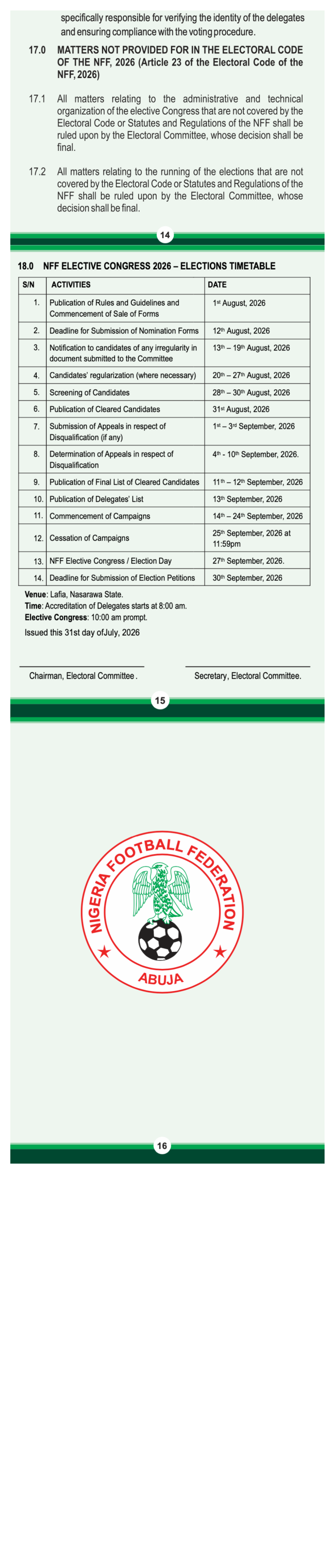
A notary or a person of equivalent legal status recognised by the courts shall attend the Congress and draw up the minutes of the elections according to the provisions of national law. He shall be specifically responsible for verifying the identity of the delegates and ensuring compliance with the voting procedure.
23 Matters not provided for herein
1 All matters relating to the administrative and technical organisation of the elective Congress that are not covered by this Electoral Code or by the Statutes and regulations of the NFF shall be ruled upon by the Electoral Committee, whose decision shall be final.
2 All matters relating to the running of the elections that are not covered by this Electoral Code or by the Statutes and regulations of the NFF shall be ruled upon by the Electoral Committee, whose decision shall be final.
Article 24 Enforcement
This Electoral Code was adopted by the Congress in Yenagoa, Bayelsa State on 23 March 2026 and comes into force on 24 March 2026.
Yenagoa, Bayelsa State, Nigeria. 23 March 2026 For the Nigeria Football Federation
Statutes of Nigeria Football Federation
I. GENERAL PROVISIONS
Article 1
Legal form, headquarters and trademarks
1
the Federal Republic of Nigeria. It is formed for an unlimited period.
2 3 4 5 6
The headquarters of the NFF are located in Abuja. Package B, MKO Abiola National Stadium, Abuja, FCT. The NFF is a member of FIFA and of CAF.
The flag, emblem and logo of the NFF are contained in Annex A of these Statutes.
The abbreviation of the Nigeria Football Federation is the NFF.
The flag, emblem, logo and abbreviation are legally registered with “ the Trademarks’ Registry of the Federal Ministry of Trades and Industry”.
The NFF is a private organisation of an associative nature established in compliance with the legislation of
Article 2 Objectives
The objectives of the NFF are:
a) to improve the game of football constantly and promote, regulate and control it throughout the territory of the Nigeria in the light of fair play and its unifying, educational, cultural and humanitarian values, particularly through youth and development programmes;
b) to organise competitions in association football, futsal and beach soccer at national level, by defining precisely, as required, the areas of authority conceded to the various leagues of which it is composed;
c) to draw up regulations and provisions and ensure their enforcement;
d) to protect the interests of its Members;
e) to respect and prevent any infringement of the Statutes, regulations, directives and decisions of FIFA, of CAF and of the NFF as well as the Laws of the Game, and to ensure that these are also respected by its Members;
f) to promote integrity, ethics and fair play with a view to preventing all methods or practices, such as corruption, doping or match manipulation, which might jeopardise the integrity of matches, competitions, players, officials and Members or give rise to abuse of association football, futsal or beach soccer;
g) to promote and strengthen good governance principles and practices at national level and encourage its Members to adopt their own good governance principles;
h) to promote the development of women’s football and the full participation of women at all levels of football governance;
i) To promote and develop youth football in all its ramifications;
j) to control and supervise all friendly football matches of all forms played throughout the territory of the Federal Republic of Nigeria;
k) to control and supervise association football, futsal and beach soccer at national level and to control and supervise all forms of international football matches played throughout the territory of the Federal Republic of Nigeria, in accordance with the relevant Statutes and regulations of FIFA and of the confederations;
6
Article 3
Article 4
Article 5
l) to manage international sporting relations connected with association football, futsal and beach soccer and to maintain a good and cooperative relationship with other Associations, CAF and FIFA;
m) to host competitions at international and other levels;
n) to raise revenues through active marketing, sponsorship and merchandizing.
Human rights
The NFF is committed to respecting all internationally recognised human rights and shall strive to promote the protection of these rights.
Non-discrimination and equality
Discrimination of any kind against a country, private person or group of people on account of race, skin colour, ethnic, national or social origin, gender, disability, language, religion, political opinion or any other opinion, wealth, birth or any other status, sexual orientation or any other reason is strictly prohibited and punishable by suspension or expulsion and/or other disciplinary measures.
Neutrality and institutional independence
1
The NFF is neutral in matters of politics and religion.
2
own members remain neutral.
The Members of the NFF shall also be neutral in matters of politics and religion and shall ensure that their
3
manage its affairs independently and shall ensure that its own affairs are not influenced by any third parties.
The NFF shall remain independent and shall avoid any form of undue political interference. The NFF shall
Article 6
Promoting friendly relations
1
humanitarian objectives.
The NFF shall promote friendly relations between its Members, Clubs, Officials and Players and in society for
2
between the Members, Clubs, Officials and Players.
The NFF shall provide the necessary institutional means to resolve any internal dispute that may arise
7
Article 7 Players
1
in accordance with the FIFA Regulations on the Status and Transfer of Players.
The status of players and the provisions for their registration shall be regulated by the Executive Committee Players shall be registered in accordance with the regulations of the NFF.
Article
2
8 Laws of the Game
1
issued by The IFAB. Only The IFAB may lay down and alter the Laws of the Game.
The NFF and each of its Members shall play association football in compliance with the Laws of the Game
2
FIFA. Only FIFA may lay down and alter the Futsal Laws of the Game.
The NFF and each of its Members shall play futsal in accordance with the Futsal Laws of the Game issued by
3
Game issued by FIFA. Only FIFA may lay down and alter the Beach Soccer Laws of the Game.
The NFF and each of its Members shall play beach soccer in accordance with the Beach Soccer Laws of the
Article
9 Conduct of bodies, Officials and others
1 All bodies and officials of the NFF shall observe the Statutes, regulations, directives, decisions and the Code of Ethics of FIFA, of CAF and of the NFF in their activities.
2 Every person and organisation involved in the game of association football, futsal and beach soccer in the territory of the Federal Republic of Nigeria is obliged to observe the Statutes and regulations of FIFA, of CAF, of the NFF and any other relevant statutes which are accepted by FIFA, CAF and the NFF, as well as the principles of fair play, loyalty, integrity and sportsmanship.
10 Official languages
1 The official language of the NFF shall be English. Official documents and texts shall be written in this language. In the event of any divergence in the interpretation of texts in different languages, the text written in English shall be authoritative.
2
Article
The official language at the Congress shall be English.
8
II. MEMBERSHIP
Article
11 Admission, suspension and expulsion
1
2 Admission may be granted if the applicant fulfils the requirements of the NFF in accordance with these Statutes.
3 Membership is terminated by dissolution, resignation or expulsion. Loss of membership does not relieve the Member from its financial obligations towards the NFF or other Members of the NFF, but leads to the loss of all rights in relation to the NFF.
4 The NFF shall ensure that all relevant stakeholders are represented within its Congress. The interests of women’s football shall also be adequately represented in the Congress.
12 Members
The Congress shall decide whether to admit, suspend or expel a Member.
Article
1
The Members of the NFF are:
Abia State Football Association
Adamawa State Football Association
Akwa Ibom State Football Association
Anambra State Football Association
Bauchi State Football Association
Bayelsa State Football Association
Benue State Football Association
Borno State Football Association
Cross River State Football Association
Delta State Football Association
Ebonyi State Football Association
Edo State Football Association
Ekiti State Football Association
Enugu State Football Association
Gombe State Football Association
Imo State Football Association
Jigawa State Football Association
Kaduna State Football Association
Kano State Football Association
Katsina State Football Association
Kebbi State Football Association
Kogi State Football Association
Kwara State Football Association
Lagos State Football Association
Nasarawa State Football Association
Niger State Football Association
Ogun State Football Association
Ondo State Football Association
Osun State Football Association
Oyo State Football Association
Plateau State Football Association
Rivers State Football Association
9
2
3
4
33. 34. 35. 36. 37. 38. 39. 40. 41. 42. 43. 44. 45. 46. 47. 48. 49. 50. 51.
The NFF
a) b) c) d) e)
Sokoto State Football Association
Taraba State Football Association
Yobe State Football Association
Zamfara State Football Association
Federal Capital Territory (FCT) Football Association – Abuja The Nigeria Premier Football League
The Clubs of the Nigeria Premier Football League The Nigeria National League (NNL)
The Clubs of the Nigeria National League
The Nigeria Nationwide League
The Clubs of the Nigeria Nationwide League
The Nigerian Women’s Football League (NWFL)
The Clubs of the Nigerian Women’s Football League
The Nigeria Beach Soccer and Futsal League
The Nigeria Special Football Association.
The Nigerian Football Coaches Association
The Nigeria Referees Association
The Players Association recognised by the NFF
The Nigerian Association of Physical and Health Education, Recreation & Sports
shall keep a register which shall include the following information on each Member:
unique identification number; legal name;
legal form;
authorised signatories;
additional information, in particular relevant to club licensing (e.g. club structure; identity; sporting results), as decided by the Executive Committee.
Up-to-date information related to its Members shall be publicly available on the website of the NFF. Upon request, the NFF shall confirm in writing the status of a Member.
Article
13 Admission
1
the NFF.
Any legal person wishing to become a Member of the NFF shall apply in writing to the general secretariat of
2 The application must be accompanied by the following mandatory items:
a) a copy of its legally valid statutes or constitutional document and, if applicable, regulations;
b) a declaration that it will comply at all times with the Statutes, regulations and decisions of the NFF, FIFA and CAF and ensure that these are also respected, if applicable, by its own members, clubs, officials and players;
c) a declaration that it will comply with the Laws of the Game in force as laid down by The IFAB, as well as the Beach Soccer Laws of the Game and the Futsal Laws of the Game as laid down by FIFA;
d) a declaration that it will refer in the last instance (i.e. after exhaustion of all internal channels within the NFF) any dispute of national dimension arising from or related to the Statutes, regulations, directives and decisions of the NFF only to CAS, which shall definitely settle the dispute to the exclusion of any Ordinary court, unless expressly prohibited by the legislation in force in the Federal Republic of Nigeria.
e) a declaration that any dispute of international dimension arising from or related to the Statutes, regulations, directives and decisions of FIFA or of CAF may only be submitted in the last instance to CAS, as specified in the Statutes of FIFA and of CAF;
10
Article
f) a declaration that it recognises the arbitration tribunal that the NFF has recognised, as specified in these Statutes, as well as the jurisdiction of CAS, as specified in the Statutes of FIFA and of CAF, and its decisions;
g) a declaration that it is located and registered on the territory of the Federal Republic of Nigeria;
h) a declaration to the effect that the legal composition of the applicant guarantees that it can make decisions independently of any external entity;
i) a declaration to the effect that the members of its own bodies were elected or appointed as a result of a procedure that guarantees the complete independence of the election or appointment;
j) a list of officials, specifying those who are authorised signatories with the right to enter into legally binding agreements with third parties;
k) a copy of the minutes of its last congress or constitutional meeting;
l) if applicable, a declaration that it undertakes to organise or participate in friendly matches only with the prior consent of the NFF;
m) if applicable, a declaration that it will play all official home matches on the territory of the Federal Republic of Nigeria.
14 Request and procedure for application
1 The procedure for admission shall be regulated by special regulations approved by the Executive Committee.
2
state the reasons for its application to the Congress.
The Executive Committee shall request that the Congress either admit an applicant or not. The applicant may
3
are eligible to vote and be elected with immediate effect.
The new Member shall acquire membership rights and duties as soon as it has been admitted. Its delegates
Article
15 Members’rights
1 The Members of the NFF have the following rights:
a) to take part in the Congress, to receive its agenda in advance, to be called to the Congress within the prescribed time, to exercise their rights to participate in the debates and discussions and to exercise their voting rights;
b) to draw up proposals for inclusion in the agenda of the Congress;
c) to nominate candidates for elections and/or appointment to the relevant bodies of the NFF;
d) to be informed of the affairs of the NFF through its official bodies;
e) to take part in competitions (if applicable) and/or other sporting activities organised by the NFF;
f) to exercise all other rights arising from the Statutes and regulations of the NFF.
2
NFF.
The exercise of these rights is subject to other provisions in the Statutes and applicable regulations of the
11
Article
16 Members’obligations
1
The Members of the NFF have the following obligations:
a) to comply fully with the Statutes, regulations, directives and decisions of FIFA, CAF and the NFF at all times and to ensure that these are also respected by its members;
b) to ensure the election of its decision-making bodies at least every 4 years;
c) to convene their supreme and legislative body once a year;
d) to take part in competitions (if applicable) and other sporting activities organised by the NFF;
e) to pay their membership subscriptions;
f) to respect the Laws of the Game as laid down by The IFAB, as well as the Beach Soccer Laws of the Game and the Futsal Laws of the Game as laid down by FIFA, and to ensure that these are also respected by its members through a statutory provision;
g) to adopt a statutory clause specifying that any dispute of national dimension arising from or related to the Statutes, regulations, directives and decisions of the NFF may only be referred in the last instance (i.e. after exhaustion of all internal channels within the NFF) to CAS, which shall definitely settle the dispute to the exclusion of any Ordinary court, unless expressly prohibited by the legislation in force in the Federal Republic of Nigeria
h) to adopt a statutory clause specifying that any dispute of international dimension arising from or related to the Statutes, regulations, directives and decisions of FIFA or of CAF may only be submitted in the last instance to CAS, as specified in the Statutes of FIFA and of CAF;
i) to manage their affairs independently and ensure that their own affairs are not influenced by any third parties in accordance with art. 21 of these Statutes;
j) to ensure that their bodies are either elected or appointed according to a procedure that guarantees the complete independence of the election or appointment;
k) to communicate to the NFF any amendment to its statutes and regulations as well as the list of its officials who are authorised signatories with the right to enter into legally binding agreements with third parties;
l) not to maintain any relations of a sporting nature with entities that are not recognised or with Members that have been suspended or expelled;
m) to observe the principles of loyalty, integrity and good sporting behaviour as an expression of fair play through a statutory provision;
n) to observe the mandatory items specified under art. 13 par. 2 of these Statutes for the duration of their affiliation;
o) to administer a register of members which shall regularly be updated and send it to NFF for their record;
p) to ratify statutes that are in accordance with the requirements of these Statutes;
q) to comply fully with all other duties arising from the Statutes and other regulations of FIFA, CAF and the NFF.
2 Violation of the above-mentioned obligations by any Member may lead to sanctions provided for in these Statutes.
3 Violation of par. 1 h) above may also lead to sanctions, even if the third-party influence was not the fault of the Member concerned. Each Member of the NFF is responsible towards it for any and all acts of the members of their bodies caused by the gross negligence or wilful misconduct of such members.
12
Article
17 Suspension
1 The Congress is responsible for suspending a Member. The Executive Committee may, however, prior to a vote of the Congress, temporarily suspend a Member, that seriously and/or repeatedly violates its obligations as a Member, having been given the right to defend himself, with immediate effect. The suspension approved by the Executive Committee shall last until the next Congress, unless the Executive Committee has lifted it in the meantime.
2 The motion for suspension must be adopted by a majority (more than 50%) of the delegates representing the Members eligible to vote is necessary for a suspension to be valid. A suspension of a Member by the Congress or the Executive Committee shall be confirmed at the next Congress by a three-quarter majority of the valid votes cast. If it is not confirmed, the suspension shall be automatically lifted.
3 A suspended Member shall lose its membership rights. Other Members may not entertain sporting contact with a suspended Member. The Disciplinary and Ethics Committee may impose further sanctions.
4 Members that do not participate in the sporting activities of the NFF for 2 consecutive years shall be suspended from voting at the Congress and their representatives shall not be elected or appointed until they have fulfilled their obligations in this respect.
18 Expulsion
1 The Congress may expel a Member if it seriously and repeatedly violates the Statutes, regulations directives or decisions of FIFA, CAF and the NFF.
2 The presence of a majority (more than 50%) of the delegates representing the Members eligible to vote at the Congress is necessary for an expulsion to be valid, and the motion for expulsion must be adopted by a three-quarter majority of the valid votes cast.
19 Resignation
1 A Member may resign with effect from the end of the football season. Notice of resignation must reach the general secretariat no later than two months before the end of the football season.
2 The resignation is not valid until the Member wishing to resign has fulfilled its financial obligations towards the NFF and its other Members, except where the NFF decides to waive all or part of such financial obligations.
20 Dissolution
1 If a Member dissolves, either voluntarily or due to legal reasons, its membership to NFF shall terminate with immediate effect at the moment its legal personality ceases to exist.
2 The executive body of the Member shall immediately inform the general secretariat of NFF when the dissolution procedure begins.
Article
Article
Article
13
Article
21 Independence of Members and their bodies
Article
22 Status of clubs, leagues, state football associations and other groups of clubs
1
Each Member shall manage its affairs independently and with no undue influence from third parties.
2
democratic procedure that guarantees the complete independence of the election or appointment.
The Members’ bodies shall be either elected or appointed. The Members’ statutes shall provide for a
3
above, even on an interim basis, shall not be recognised by the NFF.
Any Members’ bodies that have not been elected or appointed in compliance with the provisions of par. 2
4
not be recognised by the NFF.
Decisions passed by bodies that have not been elected or appointed in compliance with par. 2 above shall
1
2
3
4
5
Clubs, leagues, state football associations or any other groups of clubs affiliated to the NFF shall be subordinate to and recognised by the NFF. There shall only be one top-tier national league in the territory of Nigeria.
These Statutes define the scope of authority and the rights and duties of the entities mentioned in par. 1 above. Their statutes and regulations shall be in line with the requirements and obligations set out therein and NFF’s statutes and regulations. The NFF shall have the primary responsibility to regulate matters relating to refereeing, the fight against doping, player registration, club licensing, the imposition of disciplinary measures, including for ethical misconduct, as well as measures required to protect the integrity of competitions.
The entities mentioned in par. 1 above shall take all decisions on any matters regarding their membership independently of any external body. This obligation applies regardless of their corporate structure.
In any case, no natural or legal person (including holding companies and subsidiaries) shall exercise control over more than one club or group of clubs whenever the integrity of any match or competition could be jeopardised.
The NFF shall recognise the authority of the State Football Associations subordinate to it to administer, regulate, and control football within their states and oversee their affiliates, including clubs, leagues, players, referees and coaches in conformity with the statutes and decisions of FIFA, CAF, WAFU B and the NFF.
14
III. HONORARY PRESIDENT AND HONORARY MEMBER
Article
23 Honorarypresidentandhonorarymember
1
meritorious service to football.
2
The Executive Committee shall make these nominations.
The Congress may bestow the title of honorary president or honorary member upon any person for
3
are not entitled to vote.
The honorary president or honorary member may take part in the Congress. They may join the debates, but
15
IV. ORGANISATION
Article
24 Bodies
1 2 3 4
5 6
7 8
9
The Congress is the supreme and legislative body.
The Executive Committee is the strategic and oversight body.
The general secretariat is the executive, operational and administrative body.
Standing and ad hoc committees shall advise and assist the Executive Committee and the general secretariat in fulfilling their duties.
The club licensing bodies are in charge of the club licensing system within the NFF.
The independent committees fulfil their functions in accordance with these Statutes and applicable regulations. The independent committees are the Audit and Compliance Committee, the Electoral Committees and the Judicial Bodies.
The judicial bodies are the Disciplinary Committee, Ethics Committee and the Appeal Committee.
The bodies shall be either elected or appointed by the NFF itself without any undue external influence and in accordance with the procedures described in these Statutes. The members of the bodies shall not have previously been found guilty of any criminal offence incompatible with the position.
Any member of the bodies must withdraw from the debate and from taking a decision if there is any risk or possibility of a conflict of interest. In particular, members of the bodies shall always be aware of, and comply with, the relevant provisions of the FIFA Code of Ethics on conflicts of interest and adjust their conduct as necessary (e.g. abstain from performing their duties, notify the chairperson in cases of potential conflicts of interest, etc.).
Article
25 Dismissal of a member of a body
1 The Congress may dismiss a member of a body. The Executive Committee may also dismiss a member of a body provisionally, with the exception of the members of the independent committees. The provisional dismissal approved by the Executive Committee shall be confirmed by the next Congress, unless the Executive Committee has lifted it in the meantime. If the next Congress is of an elective nature, a dismissed member shall be allowed to be an elective candidate (provided that he fulfils the relevant eligibility criteria) on a conditional basis depending on the final decision of the Congress on his dismissal which shall be taken before the election.
2 The motion for dismissal must be justified and shall be sent to the members of the Executive Committee and/or to the Members of the NFF along with the respective agenda.
3 The member of the body in question has the right to defend himself in front of the Executive Committee and/or the Congress.
4 The motion for dismissal shall be decided by means of secret ballot at the Executive Committee and/or the Congress. For the motion to be passed, a majority of 50+1 of the valid votes cast is required.
5
The member dismissed (provisionally or not) is relieved of his functions with immediate effect.
16
A. CONGRESS
Article
26 Definition and composition
1
legislative authority of the NFF. Only a Congress that is duly convened has the authority to make decisions.
3
The Congress may be ordinary or extraordinary.
The Congress is a meeting at which all of the Members regularly convene. It represents the supreme and
2
take into account the importance of gender equality in football.
The Congress shall be constituted in accordance with the principles of representative democracy and shall
4
as well as any applicable regulations.
The President shall chair the Congress in compliance with these Statutes, the Standing Orders of the Congress,
5
or to vote.
The Executive Committee may appoint observers who take part in the Congress without the right to debate
6
but are not entitled to vote.
The honorary presidents or honorary members may take part in the Congress. They may join the debates,
Article
27 Delegatesandvotes
Abia State Football Association, represented by two delegates with one vote.
Adamawa State Football Association, represented by two delegates with one vote.
Akwa Ibom State Football Association, represented by two delegates with one vote.
Anambra State Football Association, represented by two delegates with one vote.
Bauchi State Football Association, represented by two delegates with one vote.
Bayelsa State Football Association, represented by two delegates with one vote.
Benue State Football Association, represented by two delegates with one vote.
Borno State Football Association, represented by two delegates with one vote.
Cross River State Football Association, represented by two delegates with one vote.
Delta State Football Association, represented by two delegates with one vote.
Ebonyi State Football Association, represented by two delegates with one vote.
Edo State Football Association, represented by two delegates with one vote.
Ekiti State Football Association, represented by two delegates with one vote.
Enugu State Football Association, represented by two delegates with one vote.
Gombe State Football Association, represented by two delegates with one vote.
Imo State Football Association, represented by two delegates with one vote.
Jigawa State Football Association, represented by two delegates with one vote.
Kaduna State Football Association, represented by two delegates with one vote.
Kano State Football Association, represented by two delegates with one vote.
Katsina State Football Association, represented by two delegates with one vote.
Kebbi State Football Association, represented by two delegates with one vote.
Kogi State Football Association, represented by two delegates with one vote.
Kwara State Football Association, represented by two delegates with one vote.
Lagos State Football Association, represented by two delegates with one vote.
Nasarawa State Football Association, represented by two delegates with one vote.
Niger State Football Association, represented by two delegates with one vote.
1
follows:
The Congress is composed of 108 delegates with 54 votes. The number of delegates and votes is allocated as
17
Article
28 Areasofauthority
The Congress has the following areas of authority:
a) adopting or amending these Statutes and the Standing Orders of the Congress;
b) appointing 3 Members to check the minutes and approving the minutes of the last meeting;
c) electing the President, the vice-president(s) and members of the Executive Committee;
d) electing the chairpersons, the deputy chairpersons and members of the independent committees (i.e. Audit and Compliance Committee, Electoral Committees and Judicial Bodies), upon proposal of the Executive Committee;
e) appointing scrutineers to count the votes and to assist the General Secretary in distributing the ballot papers issued for the elections;
2
3
4
Ogun State Football Association, represented by two delegates with one vote.
Ondo State Football Association, represented by two delegates with one vote.
Osun State Football Association, represented by two delegates with one vote.
Oyo State Football Association, represented by two delegates with one vote.
Plateau State Football Association, represented by two delegates with one vote.
Rivers State Football Association, represented by two delegates with one vote.
Sokoto State Football Association, represented by two delegates with one vote.
Taraba State Football Association, represented by two delegates with one vote.
Yobe State Football Association, represented by two delegates with one vote.
Zamfara State Football Association, represented by two delegates with one vote.
Federal Capital Territory (FCT) Football Association – Abuja, represented by two delegates with one
vote.
The Nigeria Premier Football League, represented by two delegates with one vote.
The top 5 clubs of the Nigeria Premier Football League, based on the final standings of the most
recent completed season, each will be represented by two delegates with one vote each.
The Nigeria National League (NNL), represented by two delegates with one vote.
The Champion of the Nigeria National League (NNL), based on the final standings of the most recent
completed season, represented by two delegates with one vote.
The Nigeria Nationwide League, represented by two delegates with one vote.
The Nigerian Women’s Football League (NWFL), represented by two delegates with one vote.
The Champion of the Nigerian Women’s Football League, represented by two delegates with one
vote.
The Nigeria Beach Soccer and Futsal League, represented by two delegates with one vote.
The Nigeria Special Football Association, represented by two delegates with one vote.
The Nigerian Football Coaches Association, represented by two delegates with one vote.
The Nigeria Referees Association, represented by two delegates with one vote.
The Players Association, recognised by the NFF, represented by two delegates with one vote.
The Nigerian Association of Physical and Health Education, Recreation & Sports, represented by two
delegates with one vote.
Delegates must belong to the Member that they represent and be appointed or elected by the appropriate body of that Member. They must also be able to produce evidence of this upon request.
Delegates and votes shall be allocated in accordance with par. 1 above. Only the delegates present are entitled to vote. Voting by proxy or by letter is not permitted.
The members of the Executive Committee and the General Secretary shall take part in the Congress without voting rights. During their terms of office, members of the Executive Committee may not be appointed as delegates to the Congress.
18
Article
f) approving the annual audited financial statements, including the consolidated financial statements and the annual report;
g) approving the budget;
h) approving the activity report (containing the activities of the NFF since the last Congress);
i) appointing the independent and external auditors upon proposal of the Executive Committee;
j) fixing the membership subscriptions upon proposal of the Executive Committee;
k) bestowing the title of honorary president or honorary member, upon proposal of the Executive Committee;
l) admitting, suspending or expelling a Member;
m) dismissing a member of a body of the NFF;
n) dissolving the NFF and deciding upon the utilisation of its financial assets;
o) passing decisions at the request of a Member in accordance with these Statutes or passing any decision entrusted to the Congress in accordance with these Statutes;
29 Quorum
1 Decisions passed by the Congress shall only be valid if a majority (more than 50%) of the delegates representing the Members eligible to vote are present.
2
3 A quorum is not required for the second meeting of the Congress unless an item on the agenda proposes the amendment of these Statutes, the election of the President, vice-presidents or members of the Executive Committee, the election of the chairpersons, deputy chairpersons or members of the independent committees, the dismissal of a member of a body, the suspension or expulsion of a Member or the dissolution of the NFF.
4 Once it is declared that the Congress has been convened and composed in accordance with these Statutes, the quorum shall not be influenced by delegates departing.
30 Decisions
If a quorum is not achieved, a second Congress shall take place within 24 hours with the same agenda.
Article
1
2
A decision that requires a vote shall be reached by a show of hands or by means of an electronic count, unless decided otherwise by the Congress. If a show of hands does not result in a clear majority in favour of a motion, the vote shall be taken by calling the roll in alphabetical order.
Unless otherwise stipulated in these Statutes, a majority (more than 50%) of the valid votes cast is sufficient for a decision to be valid. Blank ballot papers, invalid votes or electronic votes manipulated in any way as well as abstentions shall be disregarded when calculating the majority.
19
Article
31 Elections
1 2
3
4
5
6
7
8
9
10
Elections shall be conducted by secret ballot.
Elections shall be conducted in accordance with the Electoral Code of the NFF and shall be supervised by the Electoral Committee.
The election for the positions within the Executive Committee shall take place by position. At least one position shall be reserved for a female candidate. Every candidate in the election for the positions of President, First Vice-President or Third Vice-President within the Executive Committee shall be proposed by at least one Member from each of the six geopolitical zones in Nigeria (a Total of 6 support letters). Every candidate for the other positions within the Executive Committee in the election shall be proposed by at least 3 Members from 3 different geopolitical zones in Nigeria. Each Member shall support one candidate for each given position only. If a Member supports more than one candidate, none of its expressions of support shall be considered valid.
A majority (more than 50%) of the valid votes cast is necessary for the election of the President and vice- president(s) of the NFF. If there are more than two candidates for the office of President or for any of the offices of vice presidents, whoever obtains the lowest number of votes is eliminated after each ballot until only two candidates are left.
For the election of the other members of the Executive Committee, the candidate(s) who receive(s) the most votes in respect of the free seat(s) shall be elected.
For the election of the chairpersons, deputy chairpersons and members of the independent committees (i.e. Audit and Compliance Committee, electoral committees and judicial bodies), the candidate(s) who receive(s) the most votes in respect of the free seat(s) shall be elected. These elections may be conducted en bloc. However, at the request of more than 50% of the delegates representing the Members, a separate vote for a specific candidate shall take place.
In case of a tied vote in any elections of any body, two new ballots shall be conducted in accordance with the procedure set forth in this article. If the tied vote remains, the relevant position shall remain vacant until a new elective Congress convenes to proceed with new elections according to these Statutes.
Blank ballot papers, invalid votes or electronic votes manipulated in any way, as well as abstentions, shall be disregarded when calculating the majority.
Candidatures for any of the positions of the Executive Committee shall be sent to the general secretariat at least 45 days before the relevant elective Congress. The official list of candidates must be passed to the Members of the NFF at least ten days before the Congress at which the Executive Committee shall be elected. The provisions of this paragraph shall also apply when elections take place during an Extraordinary Congress.
Candidatures for any of the positions of the independent committees (i.e. Audit and Compliance Committee, electoral committees and judicial bodies) shall be sent to the general secretariat at least 30 days before the elective Congress. The official list of candidates must be passed to the Members of the NFF at least ten days before the Congress at which the members in question shall be elected.
Article
32 OrdinaryCongress
1
The Ordinary Congress shall be held every year.
20
Article
2 The Executive Committee shall fix the place and date. The Members shall be notified in writing at least 60 days in advance.
3 Any proposal that a Member wishes to submit to the Congress shall be sent to the general secretariat in writing, with a brief explanation, at least 30 days before the date of the Congress.
4 The formal convocation shall be made in writing at least ten days before the date of the Congress. This convocation shall contain the agenda, the activity report, the financial statements, the independent and external auditors’ report and any other relevant documents.
33 OrdinaryCongressagenda
1
The General Secretary shall draw up the agenda based on proposals from the Executive Committee and the Members.
2
The Congress agenda shall include the following mandatory items (in chronological order):
a) b)
c) d) e) f) g) h) i) j) k) l)
m)
n)
o) p) q)
a declaration that the Congress has been convened and composed in compliance with these Statutes; approval of the agenda;
an address by the President;
appointment of Members to check the minutes;
appointment of scrutineers;
suspension or expulsion of Members (if applicable);
approval of the minutes of the preceding Congress;
activity report (containing the activities since the last Congress);
presentation of the consolidated and revised balance sheet and the profit and loss statement;
approval of the financial statements;
approval of the budget;
votes on proposals for amendments to these Statutes and the Standing Orders of the Congress (if applicable);
discussion of proposals submitted by the Members and the Executive Committee in accordance with the procedure stipulated under art. 31 par. 3 of these Statutes;
appointment of the independent and external auditors (if applicable) upon proposal of the Executive Committee;
dismissal of a member of a body of the NFF (if applicable);
election of the President, vice-presidents and members of the Executive Committee (if applicable);
elections of the members of the independent committees, i.e. the Audit and Compliance Committee, electoral committees and judicial bodies (if applicable);
admission for membership (if applicable).
The Congress shall not take a decision on any point not included in the agenda.
r)
3
4 The agenda of an Ordinary Congress may be altered, provided that more than 50% of the delegates representing the Members present at the Congress and eligible to vote agree to such a motion.
21
Article
34 Extraordinary Congress
Article
35 Amendments to the Statutes, the Electoral Code and Standing Orders of the Congress
1
2 The Executive Committee shall convene an Extraordinary Congress if two-thirds of the delegates representing the Members of the NFF make such a request in writing (The request must include the signatures and confirmation of all the delegates presenting the request). The request shall specify the items to be included in the agenda. An Extraordinary Congress shall be held within a maximum of 30 days of receipt of the request. If an Extraordinary Congress is not convened, the delegates representing the Members who requested it may convene the Congress themselves. In doing so, they shall inform all the Members of the NFF and the Executive Committee of the date and location of the Extraordinary Congress, along with the items to be included in the agenda in accordance with par. 3 below.
3 The Members shall be notified of the place, date and agenda at least ten days before the date of an Extraordinary Congress.
4 When an Extraordinary Congress is convened on the initiative of the Executive Committee, it must draw up the agenda. When it is convened upon the request of the Members, the agenda must contain the points raised by those Members.
5
The Executive Committee may convene an Extraordinary Congress at any time.
The agenda of an Extraordinary Congress must not be altered.
1
2
3
The Congress is responsible for amending these Statutes, the Electoral Code and the Standing Orders of the Congress.
Any proposals for an amendment to these Statutes, the Electoral Code and the Standing Orders of the Congress must be submitted in writing with a brief explanation to the general secretariat by a Member or by the Executive Committee. A proposal submitted by a Member is valid, provided it has been supported in writing by at least 10 other Members.
For a vote on an amendment to the Statutes, to the Electoral Code and to the Standing Orders of the Congress to be valid, a majority (more than 50%) of the delegates representing the Members eligible to vote must be present.
Article
4 A proposal for an amendment to these Statutes, to the Electoral Code and to the Standing Orders of the Congress shall be adopted only if one third of the delegates representing the Members present and eligible to vote agree to it.
36 Minutes
The General Secretary shall be responsible for recording the minutes at the Congress. The minutes shall be checked by those Members designated, and finally approved at the next Congress.
22
Article 37 Effective dates of decisions
Decisions passed by the Congress shall come into effect immediately after the close of the Congress, unless
otherwise stipulated in these Statutes or unless the Congress fixes another date for a decision to take effect.
23
B. EXECUTIVE COMMITTEE
Article
38 Composition
2
3
4
5
6
7
8
The President, the first and third vice-president(s), Chairman of Chairmen, and the other members of the Executive Committee shall be elected by the Congress in accordance with art. 31 of these Statutes. They shall undergo an integrity check, to be conducted by the Audit and Compliance Committee, before their election or re-election.
The mandate of the President, vice-presidents, Chairman of Chairmen and the other members of the Executive Committee shall be for four years. Their term of office shall follow the same electoral cycle. Their mandates shall immediately begin after the end of the Congress which has elected them and expire at the end of the Congress at which their successors are elected.
All members of the Executive Committee shall have already been active in football for 4 years out of the last 6 years and shall fulfil the prerequisites stipulated in art. 24 par. 8 of these Statutes.
A member of the Executive Committee may not at the same time be a member of an independent committee and may not be appointed/elected as a delegate representing a Member at the Congress.
If a position or up to 50% of the positions of the Executive Committee become vacant, the Executive Committee shall fill the position(s) in question until the next Congress, when replacement(s) for the position(s) will be elected for the remaining period of office.
If more than 50% of the positions of the Executive Committee become vacant, the General Secretary shall convene an Extraordinary Congress within the prescribed period of time. In the meantime, the remaining members of the Council shall take care of the daily affairs of the NFF until new elections are held.
Any position within the Executive Committee shall be considered vacant in case of death, resignation or if the member concerned is permanently prevented from performing his official function.
1
The Executive Committee shall consist of 19 members as follows:
a) b) c)
d) e) f) g)
h) i) j)
President;
First Vice-President;
Second Vice-President (the Chairperson of the Nigeria Premier Football League (NPFL) shall, ex officio, be the Second Vice-President of the NFF).
Third Vice-President, who shall be a woman; Chairman of Chairmen and;
Ten (10) elected ordinary members;
One (1) ordinary member representing the Nigeria National League (the Chairperson of the Nigeria National League shall, ex officio, be such ordinary member);
One (1) ordinary member representing the Nigeria Nationwide Amateur League (the Chairperson of the Nigeria Nationwide Amateur League shall, ex officio, be such ordinary member)
One (1) ordinary member representing the Nigerian Women’s Football League (the Chairperson of the Nigerian Women’s Football League shall, ex officio, be such ordinary member);
One (1) co-opted member to be nominated by the President and approved by the Executive Committee.
24
Article 39
Meetings
1 2
3
4
5
6
The Executive Committee shall meet at least four times a year.
The President shall convene the Executive Committee meetings through the General Secretariat. If a majority (more than 50%) of the Executive Committee members request a meeting, the President shall convene it so that the meeting is held within 14 days of the receipt of the request. If the President does not convene the requested meeting by the aforementioned deadline, the other members of the Executive Committee shall convene it themselves, but must send the agenda to all members of the Executive Committee at least three days before the meeting in line with par. 3 below.
The President, assisted by the general secretariat, shall compile the agenda. Each member of the Executive Committee is entitled to propose items for inclusion in the agenda. The members of the Executive Committee must submit the items they wish to include on the agenda for the meeting to the general secretariat at least 7 days before the meeting. The agenda must be sent out to the members of the Executive Committee at least 3 days before the meeting.
The General Secretary shall take part in the meetings of the Executive Committee in a consultative role and without voting rights. If the General Secretary is unable to attend a meeting, he may nominate a representative to attend the meeting on his behalf, subject to the approval of the Executive Committee.
The meetings of the Executive Committee shall not be held in public. The Executive Committee may, however, invite third parties to attend. Those third parties shall not have voting rights, and may only express an opinion with the permission of the Executive Committee.
The President may also convene the Executive Committee on an urgent basis to deal with any matter requiring immediate settlement between two meetings of the Executive Committee. If the members of the Executive Committee cannot meet physically, decisions may be passed through other modern means of written communication (e.g. emails or messaging apps).
Article
40 Powers
The Executive Committee shall have the following powers:
a) passing decisions on all cases that do not come within the sphere of responsibility of the Congress or are not reserved for other bodies by law or under these Statutes.
b) preparing, with the assistance of the general secretariat, and convening the Ordinary and Extraordinary Congress.
c) appointing the chairpersons, deputy chairpersons and members of the standing committees.
d) deciding to set up ad hoc committees if necessary at any time.
e) approving and issuing the regulations for the organisation of standing committees and ad hoc committees.
f) appointing and dismissing the General Secretary upon proposal of the President.
g) proposing the independent and external auditors to the Congress.
h) appointing replacements for vacancies in the independent committees until the next Congress.
i) approving and issuing regulations governing the conditions of participation in and the staging of competitions organised by the NFF.
25
4
The decisions taken shall be recorded in the minutes.
j)
k) l) m)
n) o) p)
approving and issuing regulations regarding a club licensing system governing the participation of clubs in the competition of NFF and CAF, in compliance with the minimum requirements of the club licensing system as set up by CAF and FIFA;
appointing the coaches for the representative teams and other technical staff.
approving and issuing the Internal Organisation Regulations of the NFF.
ensuring that these Statutes are applied and adopting the executive arrangements required for their application.
dismissing a member of a body or suspending a Member of the NFF provisionally until the next Congress; delegating tasks under its authority to other bodies.
appointing observers who may take part in the Congress without the right to debate or to vote.
Article
41 Decisions
1
The Executive Committee shall not engage in valid debate unless 50+1 of its members are present.
2
by proxy or by letter is not permitted.
The Executive Committee shall reach decisions by a majority (more than 50%) of the valid votes cast. Voting
3
is any risk or possibility of a conflict of interests.
Any member of the Executive Committee must withdraw from the debate and from taking a decision if there
5
Committee decides otherwise.
The decisions taken by the Executive Committee shall come into effect immediately, unless the Executive
26
C. PRESIDENT
Article
42 President
1
2 Only the President may propose to the Executive Committee the appointment of the General Secretary. The President may, however, also propose to the Executive Committee the dismissal of the General Secretary.
3 The President shall preside over the Congress and the Executive Committee meetings and those committees of which he has been appointed chairperson.
4
5 If the President is absent or unavailable, the First Vice-President shall deputise. Where the First Vice- President is also absent or unavailable, the Second Vice-President shall deputise accordingly. In the circumstance that both the First and Second Vice-Presidents are absent or unavailable, the Third Vice- President shall deputise until the President or a higher-ranking Vice-President becomes available.
6 If the position of the President becomes vacant in the sense of art. 38 par. 8 of these Statutes, the first vice- president shall deputise until the next Congress. In case the 1st Vice-President position is also vacant, the 2nd Vice-President shall deputise until the next Congress. If the positions of the President, the 1st Vice-President, and the 2nd Vice-President are all vacant, the 3rd Vice-President shall deputise until the next Congress. This Congress shall elect a new President for the remaining period of office.
7
The President is primarily responsible for:
a) implementing the decisions passed by the Congress and the Executive Committee through the general secretariat;
b) ensuring the effective functioning of the bodies in order that they achieve the objectives described in these Statutes;
c) supervising the work of the general secretariat;
d) the relations between the NFF and its Members, FIFA, CAF, political bodies and other organisations.
The President shall have an ordinary vote on the Executive Committee.
Any additional powers of the President shall be contained in the Internal Organisation Regulations of the NFF.
Article
43 Representation and signature
2
1
Internal Organisation Regulations of the NFF regarding the joint signature of office holders.
The President represents the NFF generally. The Executive Committee shall adopt special provisions in the All legal documents must be signed by the President and the General Secretary of the NFF.
27
D. GENERAL SECRETARIAT
Article
Article
44 GeneralSecretariat
The general secretariat is the executive, operational and administrative body and shall carry out the work of the NFF under the direction of the General Secretary. The members of the general secretariat are bound by the Internal Organisational Regulations of the NFF and shall fulfil the given tasks in good faith.
45 GeneralSecretary
1
2 The General Secretary shall be appointed by the Executive Committee upon proposal of the President on the basis of an agreement governed by private law and shall have the necessary professional qualifications and/or experience.
3
The General Secretary is the chief executive officer of the NFF.
The General Secretary shall be responsible for:
a) implementing decisions passed by the Congress and Executive Committee in compliance with the President’s directives;
b) attending the Congress and meetings of the Executive Committee and the standing and ad hoc committees;
c) organising the Congress and meetings of the Executive Committee and other bodies;
d) compiling the minutes for the meetings of the Congress, Executive Committee and standing and ad hoc committees;
e) managing and keeping the accounts;
f) correspondence;
g) the relations with the Members, committees, FIFA and CAF, under the direction of the President;
h) organising the general secretariat;
i) the appointment and dismissal of staff working in the general secretariat;
j) providing the electoral committees with logistic and operative support for the elections, upon request from the Electoral Committees.
4 Any additional responsibilities and duties assigned to the General Secretary shall be stipulated in the Internal Organisation Regulations of the NFF.
5 The General Secretary shall not be a Congress delegate, a member of any affiliate or a member of any other body of NFF.
28
E. STANDING COMMITTEES
Article
46 Standing Committees
Article
47 Finance Committee
The Finance Committee shall monitor the financial management and advise the Executive Committee on financial matters and asset management. It shall analyse the budget and the financial statements prepared by the General
2
3
4
5
6
7
Chairpersons, deputy chairpersons and members of the standing committees may be members of the Executive Committee. The members of each standing committee shall be appointed by the Executive Committee upon proposal of the Members of the NFF or the President. The Executive Committee shall ensure appropriate female representation on standing committees. The chairpersons, deputy chairpersons and the members of the standing committees shall be designated for a term of office of two years.
Each chairperson shall represent his standing committee and conduct business in compliance with the relevant provisions of the Internal Organisation Regulations of the NFF approved by the Executive Committee.
Each chairperson shall fix the dates of meetings in collaboration with the General Secretary, ensure that all tasks are carried out and report back to the Executive Committee through the General Secretary.
The Executive Committee and each standing committee, the latter with the approval of the Executive Committee, may, if necessary, set up a bureau and/or sub-committee to settle urgent matters. Any discussions and decisions of the bureau and/or sub-committee shall be reported to the relevant standing committee as soon as it is practicable to do so.
Each standing committee may propose to the Executive Committee amendments to the relevant provisions of the Internal Organisation Regulations of the NFF that concern its committee.
The members of the standing committees shall have altogether the capacity, knowledge, ability and experience required to fulfil the tasks and duties of their respective committees. The Executive Committee shall ensure appropriate female and stakeholders’ representation on standing committees.
1
The standing committees are:
a) Finance Committee;
b) Organising Committee for the NFF Competitions;
c) Technical and Development Committee;
d) Referees Committee;
e) Committee for Women’s Football;
f) Players’ Status Committee;
g) Legal Committee;
h) Safety & Security Committee;
i) Stadia and Infrastructure Committee;
j) Marketing, Sponsorship & TV Committee;
k) Medical and Anti-Doping Committee;
l) Youth Football Committee (Men);
m) Youth Football Committee (Women);
n) Futsal /Beach Soccer Committee;
o) Stakeholders Engagement Committee;
p) Media and Communication Committee;
q) Member Associations Committee.
29
Article
Article
Secretary and submit them to the Executive Committee for approval. It shall consist of a chairperson, a deputy chairperson and 5 members.
48 Organising Committee for the NFF Competitions
The Organising Committee for the NFF Competitions shall propose to the NFF Executive Committee the policies, guidelines and regulations for the organization of the NFF competitions of association football, futsal and beach soccer at any level within the NFF in compliance with the provisions of these Statutes and the regulations applicable to the NFF’s competitions. It shall consist of a chairperson, a deputy chairperson and 8 members.
49 TechnicalandDevelopmentCommittee
The Technical and Development Committee shall primarily analyse the basic aspects of football training and technical development in football. It shall also be in charge of the NFF’s development programmes, devising and proposing appropriate strategies, monitoring these strategies and analysing the support and programmes provided to the Members of the NFF and providing advice to the Executive Committee on development matters in general. It shall consist of a chairperson, a deputy chairperson and 5 members.
50 RefereesCommittee
1 The referees committee must be an integral part of the member association’s structure. It shall be responsible for the organisation, regulation and development of refereeing. It must be under the exclusive control of the member association and shall under no circumstances fall under the supervision or control of other bodies, such as leagues or governments (including parliaments and any other state authorities).
2 The referees committee shall be composed only of former match officials (preferably having operated at the top level of their respective domestic competition) with a chairman, a deputy chairman and an adequate number of other members. They shall not be affiliated to any clubs, leagues, any other football organisation or any other referee organisation (union, membership group, etc.). Active match officials shall not be eligible to serve on any referees’ committee.
3 The chairman of the referees committee must be a former top-level match official. The deputy chairman and the other members of the referees committee shall be appointed by the president of the NFF.
4 The duties of the referees committee shall be defined by the executive committee of the NFF and shall, at a minimum, include the following:
a) Classify match officials in each category based on evaluations of their performance, as well as determine promotions or demotions.
b) Approve the appointment of match officials for competitions organised under the jurisdiction of the NFF;
c) Oversee the nomination of candidates for the FIFA Refereeing International Lists according to the FIFA Regulations Governing the Registration of International Match Officials;
d) Supervise the enforcement of the Laws of the Game in all the competitions organised under the jurisdiction of the NFF;
e) Comply with standard refereeing methodology as established by FIFA to ensure uniform implementation of the Laws of the Game;
f) Utilise uniform criteria for evaluating referees as established by FIFA;
Article
30
Article
Article
g) Select and approve national refereeing coaches (includes instructors, assessors, match analysts and any other individuals who directly impact the performance and development of match officials);
h) Approve administrative regulations governing refereeing.
51 CommitteeforWomen’sFootball
The Committee for Women’s Football shall propose to the NFF Executive Committee the policies, guidelines and regulations for the organisation of the NFF women’s football competitions and deal with all matters relating to women’s football. It shall consist of a chairperson, a deputy chairperson and 5 members. At least 4 members must be women.
52 Players’ Status Committee
Article
53 LegalCommittee
1 The Legal Committee shall examine NFF legal related aspects. It shall further ensure compliance with the statutes, operating regulations, and agreements of the NFF, CAF, FIFA, and other applicable local and international statutory, regulatory, and legislative requirements.
2 The Legal Committee shall consist of a chairperson, a deputy chairperson and 5 members, all of whom must be qualified to deal with legal matters.
3 The duties of the legal committee shall be defined by the Executive Committee and shall, at a minimum, include the following:
a) advising the Executive Committee on matters relating to the interpretation and amendment of the NFF Statutes, Regulations, and other governing documents, as referred to it by the Executive Committee;
b) assessing and making recommendations on other matters relating to football governance and regulations, as may be referred to it by the Executive Committee or Congress;
c) on the direction of Congress or the Executive Committee, or on its own initiative with prior Executive Committee approval, studying issues affecting football laws and regulations, preparing drafts of amendments or new regulations, and submitting reports and recommendations thereon;
d) making recommendations to the Executive Committee regarding representation at sessions or meeting of other Standing Committees and with other NFF bodies or external organisations, and any other matters that enhance the effective governance of the NFF;
e) Analyse, from time to time, the statutes and regulations of NFF Members to ensure compliance with NFF, CAF, and FIFA Statutes.
1
2
The Players’ Status Committee shall set up and monitor compliance with transfer regulations in accordance with the FIFA Regulations on the Status and Transfer of Players and determine the status of players for the various competitions of the NFF. The Executive Committee may approve special regulations governing the Players’ Status Committee’s powers of jurisdiction. The Players’ Status Committee shall consist of a chairperson, a deputy chairperson and 5 members.
Players’ status disputes involving the NFF, its Members, clubs, players, officials, intermediaries and licensed match agents shall be settled in the last instance by CAS in accordance with these Statutes and subject to any applicable national law.
31
Article
Article
Article
Article
54 Safety and Security Committee
The Safety and Security Committee shall primarily oversee all matters related to the safety and security of football events and activities. It shall be responsible for developing and proposing strategies to ensure a secure environment, monitoring the implementation of these strategies, and providing guidance on risk assessment and management. It shall consist of a chairperson, a deputy chairperson and 5 members.
55 Stadia and Infrastructure Committee
The Stadia and Infrastructure Committee shall primarily oversee the planning, development, and maintenance of football stadia and infrastructure. It shall be responsible for proposing strategies, monitoring projects, and ensuring compliance with stadia and infrastructure standards of Nigeria, CAF stadium regulations and the FIFA stadium guidelines. It shall consist of a chairperson, a deputy chairperson and 5 members.
56 Marketing, Sponsorship and TV Committee
The Marketing, Sponsorship and TV Committee shall primarily manage and oversee all matters related to marketing, sponsorship, and broadcasting rights for football. It shall be responsible for devising strategies, assisting the NFF general secretariat in securing sponsorships, enhancing brand visibility, and monitoring the implementation of agreements. It shall consist of a chairperson, a deputy chairperson and 5 members.
57 Medical and Anti-Doping Committee
The Medical and Anti-Doping Committee shall deal with all medical aspects of football, including the fight against doping. Its duties shall include, but not limited to, advising and monitoring policy and strategy in relation to: (i) all medical aspects as they apply to football and the players; (ii) injury monitoring, analysis, and management; (iii) recovery and rehabilitation; (iv) compliance with anti-doping testing and monitoring regulations set by FIFA and the World Anti-doping Agency and (v) any other matters related to player injuries, recovery, sports medicine, physical fitness, well-being, and anti-doping. It shall consist of a chairperson, a deputy chairperson and 5 members, all of whom must be qualified to deal with general and sport medicine.
58 Youth Football Committee (Men)
This committee shall primarily focus on the promotion and development of youth football for men. It shall be responsible for creating strategies, overseeing youth competitions, monitoring development programmes, and providing advice on talent identification. It shall consist of a chairperson, a deputy chairperson and 5 members.
59 Youth Football Committee (Women)
Article
Article
32
Article
This committee shall primarily focus on the promotion and development of youth football for women. It shall be responsible for creating strategies, overseeing youth competitions, monitoring development programmes, and providing advice on talent identification. It shall consist of a chairperson, a deputy chairperson and 5 members.
60 Futsal/BeachSoccerCommittee
The Futsal / Beach Soccer Committee shall primarily focus on the development and promotion of futsal and beach soccer. It shall be responsible for creating strategies, overseeing competitions, and providing guidance on the growth of these disciplines. Its duties shall include, but not limited to, advising and monitoring policy and strategy in relation to: (i) development of futsal; (ii) development and delivery of futsal competitions; (iii) development and delivery of futsal player pathways; (iv) development and delivery of futsal coach education programs; (v) development and delivery of futsal referee education programs; (vi) development of futsal clubs and facilities, including their governance and management; and (vii) affairs of the futsal national teams. It shall consist of a chairperson, a deputy chairperson, and 5 members.
61 StakeholdersEngagementCommittee
1 The Stakeholders Engagement Committee shall primarily address football matters, particularly the structure of the game and the relationship between clubs, players, leagues, and any other Members. It shall also analyse the basic aspects of football training and technical development. It shall consist of a chairperson, a deputy chairperson, and 5 members.
2 Its duties shall include, but are not limited to, advising and monitoring policy and strategy in relation to: (i) greater engagement and integration of all stakeholders; (ii) mechanisms that provide and enable assistance and support to stakeholders; (iii) developing programs and tools to build and strengthen the capabilities of Members; and (iv) any other matter relating to the fulfilment and management of stakeholders as they relate to the delivery and development of football.
62 MediaandCommunicationsCommittee
The Media and Communications Committee shall primarily oversee all matters related to media, communications, and public relations for the NFF. It shall be responsible for developing strategies to enhance the visibility and reputation of NFF, managing media relations, and ensuring effective communication with the public and stakeholders. The committee shall also be tasked with advising on media policies, including the management of media rights and the coordination of communication during major football events. It shall consist of a chairperson, a deputy chairperson, and 5 members.
63 Member Associations Committee
The Member Associations Committee shall primarily oversee the relationship between NFF and its Members. It shall be responsible for advising and supporting the NFF in strengthening the capacity of its Members, promoting good governance, and fostering collaboration and solidarity within the football community. The committee shall also focus on monitoring the implementation of NFF policies at the Members level, addressing issues related to
Article
Article
Article
33
Article
membership and affiliation, and providing guidance on the development of football across all levels. It shall consist of a chairperson, a deputy chairperson, and 5 members.
64 Adhoccommittees
The Executive Committee may, if necessary, create ad hoc committees for special duties and a limited period of time. The Executive Committee shall appoint a chairperson, a deputy chairperson and the appropriate number of members. The duties and function of ad hoc committees are defined in special regulations approved by the Executive Committee. An ad hoc committee shall report directly to the Executive Committee through the General Secretary.
F. CLUB LICENSING BODIES
Article
65 Clublicensingbodies
1
the Club Licensing Regulations of the NFF and CAF.
2
The club licensing bodies consist of a first instance body and an appeal body.
The club licensing bodies shall be in charge of the club licensing system within the NFF in accordance with
3
provisions in these Statutes.
Decisions passed by the club licensing appeal body may only be appealed before CAS in accordance with the
34
V. INDEPENDENT COMMITTEES
Article
66 Institutionalindependence
1
2
3
4
5
6
The independent committees as well as their individual members shall conduct their activities and perform their duties entirely independently but always in the interests of the NFF and in accordance with its Statutes and regulations.
The chairpersons, deputy chairpersons and members of the independent committees shall be elected by the Congress upon proposal of the Executive Committee and may only be relieved of their duties by the Congress. They shall not be members of any other body of NFF.
The mandate of all members of the independent committees shall last for four (4) years. They may be re- elected.
The chairpersons, deputy-chairpersons and members of the Audit and Compliance Committee and of the electoral committees as well as the chairpersons and deputy-chairpersons of the judicial bodies shall comply with the independence criteria as defined in par. 5 below.
The persons mentioned in par. 4 above as well as any of their immediate family members may not exercise or have exercised during the four years preceding their initial terms any executive function at NFF, one of NFF’s Members, a league or a club (including any of their affiliated companies/organisations), nor have or have had in the four years preceding their initial term any material business relationship with NFF, one of NFF’s Members, a league or a club (including any of their affiliated companies/organisations). “Immediate family member” shall mean, with respect to a person, such person’s spouse or domestic partner, siblings, parents, grandparents, uncles, aunts, children (including any stepchild or adopted child), grandchildren, son- , daughter-, father- or mother-in-law, and including anyone else, whether by blood or otherwise, with whom the individual has a relationship akin to a family relationship for which such person provides financial support.
The chairpersons, deputy-chairpersons and members of the independent committees shall undergo an integrity check to be conducted by the Electoral Committee prior to their election or re-election.
Article
67 Audit and Compliance Committee
1
2
The Audit and Compliance Committee shall ensure the completeness and reliability of the financial accounting and review the financial statements, the consolidated financial statement and the independent and external auditors’ reports. The Audit and Compliance Committee shall consist of a chairperson, a deputy chairperson and 5 members. Its members shall be knowledgeable and experienced in financial and/or regulatory and legal matters and may not be involved in any decision affecting the operations of the NFF.
The Audit and Compliance Committee shall advise, assist and oversee the Executive Committee in monitoring the NFF’s financial and compliance matters, set up compliance mechanisms and monitor compliance with the relevant regulations of the NFF. It shall also supervise the general secretariat in financial and compliance issues. The Audit and Compliance Committee shall ensure the completeness and reliability of the financial accounting and review the consolidated financial statements and the independent and external auditor’s report. The Audit and Compliance Committee shall furthermore monitor the NFF’s financial and compliance matters and suggest to the appropriate bodies any action that it deems necessary as a result of such monitoring. The Audit and Compliance Committee shall, with the assistance of the general secretariat, implement a compliance programme within the NFF.
3 Details on the Audit and Compliance Committee’s responsibilities, its internal cooperation and other procedural matters are stipulated in the Internal Organisation Regulations of the NFF.
35
Article
68
4 If the chairperson, the deputy chairperson or a member of the Audit and Compliance Committee permanently ceases to perform his official function during his term of office, the Executive Committee shall appoint a replacement to serve until the next Congress.
Electoral Committees
1 The electoral committees are the bodies in charge of organising and supervising the election process in accordance with the Electoral Code of the NFF. The electoral committees consist of the Electoral Committee (the first instance body) and the Election Appeal Committee (the second instance body).
2 The composition and function of the electoral committees shall be governed by the Electoral Code of the NFF.
Article
69 Judicialbodies
1
2
3
4
5
6
7
8
The judicial bodies are:
a) the Disciplinary Committee;
b) the Ethics Committee;
b) the Appeal Committee.
The judicial bodies are to be composed in such a way that the members, together, have the knowledge, abilities and specialist experience that is necessary for the due completion of their tasks and duties. The chairpersons and deputy chairpersons of the judicial bodies shall be qualified to practise law.
All members of the judicial bodies (including the chairpersons and deputy chairpersons) shall undergo an integrity check prior to their election or re-election, which shall be conducted by the Audit and Compliance Committee.
The term of office of all members shall be four years. The members may be re-elected or relieved of their duties at any time, although they may only be relieved of their duties by the Congress.
The chairpersons, deputy chairpersons and other members of the judicial bodies shall be elected by the Congress upon proposal of the Executive Committee and shall not be members of any other body of the NFF.
The chairpersons and deputy chairpersons of the judicial bodies shall fulfil the independence criteria that are stipulated in art. 56 par. 5 of these Statutes.
If the chairperson, the deputy chairperson or a member of a judicial body permanently ceases to perform his official function during his term of office, the Executive Committee shall appoint a replacement to serve until the next Congress, in which the Congress shall appoint a new member of the respective judicial body for the remaining period.
The responsibilities and function of the judicial bodies shall be stipulated in the Disciplinary Code and in the Ethics Code of the NFF.
36
Article
70 DisciplinaryCommittee
1
of other members as determined in the Disciplinary Code.
2
The function of the Disciplinary Committee shall be governed by the Disciplinary Code of the NFF.
2
The function of the Ethics Committee shall be governed by the Ethics Code of the NFF.
The Disciplinary Committee shall consist of a chairperson, a deputy chairperson and the necessary number
3
Code of the NFF on Members, officials, players, clubs, licensed match agents and intermediaries.
The Disciplinary Committee may pronounce the sanctions described in these Statutes and the Disciplinary
4
suspension and expulsion of Members.
These provisions do not affect the powers of the Congress and the Executive Committee with regard to the
5
principles laid down in the FIFA Disciplinary Code.
The Executive Committee shall issue the Disciplinary Code of the NFF, which shall be in accordance with the
Article
71 Ethics Committee
1
members as determined in the Ethics Code.
The Ethics Committee shall consist of a chairperson, a deputy chairperson and the necessary number of other
3
NFF on Members, officials, players, clubs, licensed match agents and intermediaries.
The Ethics Committee may pronounce the sanctions described in these Statutes and the Ethics Code of the
4
suspension and expulsion of Members.
These provisions do not affect the powers of the Congress and the Executive Committee with regard to the
5
principles laid down in the FIFA Ethics Code.
The Executive Committee shall issue the Ethics Code of the NFF, which shall be in accordance with the
Article
72 Appeal Committee
1
other members as determined in the Disciplinary and Ethics Code.
2
The function of the Appeal Committee shall be governed by the Disciplinary Code and Ethics Code of the NFF.
The Appeal Committee shall consist of a chairperson, a deputy chairperson and the necessary number of
3
Committee that are not declared final by the relevant regulations of the NFF.
The Appeal Committee is responsible for hearing appeals against decisions from the Disciplinary and Ethics
4
provisions in these Statutes.
Decisions pronounced by the Appeal Committee may only be referred to CAS in accordance with the
37
VI. DISCIPLINARY MEASURES
Article
73 Disciplinarymeasures
The disciplinary measures are primarily:
1
2
3
for legal persons:
a) a transfer ban;
b) playing a match without spectators;
c) playing a match on neutral territory;
d) a ban on playing in a particular stadium;
e) annulment of the result of the match;
f) expulsion from a competition;
g) a forfeit;
h) deduction of points;
i) relegation to a lower division;
j) replaying a match.
for natural and legal persons:
a) a warning;
b) a reprimand;
c) a fine;
d) the return of awards.
for natural persons:
a) a caution;
b) an expulsion;
c) a match suspension;
d) a ban from the dressing rooms and/or the substitutes’ bench;
e) a ban from entering a stadium;
f) a ban on taking part in any football-related activity;
g) social work;
h) compliance training.
38
VII. ARBITRATION
Article
74 Arbitration
1 Disputes within the NFF or disputes affecting Members of the NFF, leagues, members of leagues, clubs, members of clubs, players and officials may only be referred in the last instance (i.e. after exhaustion of all internal channels within the NFF) to CAS, which shall settle the dispute definitively to the exclusion of any ordinary court, unless expressly prohibited by the legislation in the Federal Republic of Nigeria.
2 Disputes of international dimension arising from or related to the Statutes, regulations, directives and decisions of FIFA or CAF may only be submitted in the last instance to CAS as specified in the Statutes of FIFA and of CAF.
75 Jurisdiction
Article
1
affiliated to the NFF.
The NFF shall have jurisdiction on internal national disputes, i.e. disputes between parties belonging or
2
different associations and/or confederations, in accordance with the relevant regulations.
FIFA and/or CAF shall have jurisdiction on international disputes, i.e. disputes between parties belonging to
3
passed by a FIFA body, a CAF body, the arbitration tribunal recognised by the NFF or CAS.
The NFF shall ensure its full compliance and that of all those subject to its jurisdiction with any final decision
39
VIII. FINANCE
Article 76
Financial period
1
The financial period of the NFF shall be one year and shall begin on 1 January and end on 31 December.
2
The NFF’s major duties in the future shall be guaranteed through the creation of reserves.
The revenue and expenses of the NFF shall be managed so that they balance out over the financial period.
3
up the annual consolidated accounts of the NFF with its subsidiaries as at 31 December.
The General Secretary is responsible, together with the assistance of the Finance Department, for drawing
Article
77 Revenue
The revenue of the NFF comprises:
a) b) c) d) e) f) g)
Members’ annual subscriptions;
receipts generated by the marketing of rights to which the NFF is entitled;
fines imposed by the authorised bodies;
other subscriptions and receipts in keeping with the objectives pursued by the NFF; donations;
any other revenue related to football activities;
funding from FIFA and from CAF.
Article
78 Expenses
The NFF shall bear:
a) the expenses stipulated in the budget;
b) other expenses approved by the Congress and expenses that the Executive Committee is entitled to incur within the scope of its authority;
c) all other expenses in keeping with the objectives pursued by the NFF.
79 Independentandexternalauditors
The independent and external auditors appointed by the Congress shall audit on a yearly basis the accounts approved by the Finance Committee in accordance with the appropriate principles of accounting and present a report to the Congress. The independent and external auditors shall be appointed for a period of four years. Their mandate may be renewed once.
Article
40
Article 80
Article 81 Settlement
The NFF may debit any Member’s assets and accounts to settle claims.
Article 82 Levies
The NFF may demand that a levy be paid by its Members for matches.
Membership subscriptions
1
question shall be paid within 30 days of the close of the Congress at which they are admitted.
Membership subscriptions are due on 31 March. The annual subscription for new Members for the year in
2
Executive Committee. It shall be the same for every Member and amount to no more than 100,000 Naira.
The Congress shall fix the amount of the annual subscription every 4 years on the recommendation of the
Article
83 Publication of financial data
1
k) of these Statutes once the relevant items have been approved by the Congress.
The NFF shall publish on its official website the financial documents referred to under art. 33 par. 2 i), j) and
41
IX. COMPETITIONS AND RIGHTS IN COMPETITIONS AND EVENTS
Article
84 Competitions
1 The NFF shall organise and coordinate the following official competitions held within its territory:
a) The FA Cup;
b) The Premier League;
c) The National League;
d) The Amateur League;
e) Women Football League;
f) Women FA Cup;
g) Nigeria Beach-Soccer League.
2 The Executive Committee may delegate to the NFF’s subordinate leagues the authority to organise competitions (e.g. by means of a proper and comprehensive agreement for elite football). The competitions organised by the leagues shall not interfere with those competitions organised by the NFF. Competitions organised by the NFF shall take priority.
3
The Executive Committee may issue special regulations to this end.
Article
Article
85 Clublicensing
The Executive Committee shall issue regulations regarding a club licensing system governing the participation of clubs in the competitions of the NFF and CAF, in compliance with the minimum requirements of the club licensing system as set up by CAF and FIFA.
86 Rights
1 The NFF and its Members are the original owners of all of the rights emanating from competitions and other events coming under their respective jurisdiction, without any restrictions as to content, time and place. These rights include, among others, every kind of financial rights, audio-visual and radio recording, reproduction and broadcasting rights, multimedia rights, marketing and promotional rights and incorporeal rights such as emblems and rights arising under copyright law.
2 The Executive Committee shall decide how and to what extent these rights are utilised and shall draw up special regulations to this end. The NFF shall ensure that the sale of such rights is carried out in a transparent manner and in compliance with the Statutes and regulations of the NFF as well as mandatory national laws.
87 Authorisation to distribute
1 The NFF and its Members are exclusively responsible for authorising the distribution of image and sound and other data carriers of football matches and events coming under their respective jurisdiction, without any restrictions.
2
Article
The Executive Committee shall issue special regulations to this end.
42
X. INTERNATIONAL MATCHES AND COMPETITIONS
Article
88 Internationalmatchesandcompetitions
1 The authority for organising international matches and competitions between representative teams and between leagues, club teams and/or scratch teams lies solely with FIFA, the confederation(s) and/or the association(s) concerned. No such match or competition shall take place without the prior permission of FIFA, the confederation(s) and/or the association(s) concerned in accordance with the FIFA Regulations Governing International Matches.
2
The NFF is bound by the international match calendar compiled by FIFA.
Article
Article
89 Contacts
The NFF, its Members, players, officials, licensed match agents and intermediaries may not play matches or make sporting contacts with associations that are not members of FIFA or provisional members of a confederation without the approval of FIFA.
90 Approval
1 Clubs, leagues or any other group of clubs that are affiliated to the NFF may only join another association with the authorisation of the NFF, the other association, the respective confederation(s) and FIFA.
2 Clubs, leagues or any other group of clubs that are affiliated to the NFF cannot participate in competitions on the territory of another association without the authorisation of the NFF, the other association, FIFA and the respective confederation(s) according to the FIFA Regulations Governing International Matches.
43
XI. FINAL PROVISIONS
Article
Article
91 Unforeseencontingenciesandforcemajeure
The Executive Committee shall have the power to decide on all cases of force majeure and on all matters not provided for in these Statutes; such decisions shall take into account the relevant regulations of FIFA and of CAF, as well as any applicable mandatory laws.
92 Publicationofcorporatedocuments
The NFF shall make available on its official website the following documents and information:
a) Statutes and Standing Orders of the Congress;
b) Electoral Code;
c) Disciplinary and Ethics Code;
d) Internal Organisation Regulations;
e) most important/key decisions;
f) its strategy;
g) agenda for Executive Committee and Congress meetings;
h) circular letters.
93 Dissolution
1 Any decision relating to the dissolution of the NFF requires a majority of two-thirds of all of the Members of the NFF, which must be obtained at a Congress specially convened for the purpose.
2. If the NFF is disbanded, the final Congress may choose a recipient for the assets on a basis to be specified by that Congress, by a vote of at least two-thirds.
3 If the final congress, for one reason or another, could not arrive at a conclusion, NFF’s assets shall be transferred to the agency of the Federal Government of Nigeria in charge of sports, which shall hold these assets as a trustee in accordance with the relevant professional duties until the NFF is re-established.
94 Enforcement
These Statutes were adopted during a virtual Congress held on 16 June 2026 and shall come into force on 16 June 2026. The former Statutes of the NFF are hereby repealed.
Article
Article
44
Article
95 Transitionalprovisions
The Member as defined under art. 12 of these Statutes, shall be granted a period of 24 months, as from the adoption of these Statutes, to comply with the mandatory requirements stipulated in art. 13 par. 2, as well as art. 16 par. 1 g), h), k), o) and p) of these Statutes. Any Member which does not comply with all of these requirements within the aforementioned timeframe, shall automatically lose its right to vote at the Congress and the delegate(s) of the Member in question shall not be taken into account when establishing the quorum.
The Member in question shall only regain its rights to vote at the Congress once it has fully complied with its obligations as mentioned in this paragraph.The term limits as defined in art. 38 par. 3 of these Statutes shall only apply as from the elections of the members of the Executive Committee which shall take place following the adoption of these Statutes.
The requirement to have already been active in football as provided for in art. 38 par. 4 of these Statutes shall not apply to the female candidates running for a position of members of the Executive Committee on the occasion of the first elections of the Executive Committee that shall take place following the adoption of these Statutes.
Upon adoption of these Statutes, the Executive Committee shall appoint the members of the Standing Committees as defined under art. 46 to 64 of these Statutes.
Within 12 months upon the adoption of these Statutes, the Congress shall elect the relevant members of the independent committees as defined under art. 67 to 72 of the Statutes that are not already in office. Within this same period, the Congress shall also dismiss the relevant members of the independent committees that do not comply with the independence criteria mentioned under art. 66 par. 5 of these Statutes and elect the relevant number of members to fill the positions.
The Nigeria Football Federation shall have one year as from the adoption of these Statutes to ensure that all other NFF regulations, codes and relevant legal documents are brought in line with the provisions of these Statutes.
16 June 2026
For the Nigeria Football Federation
Alhaji Ibrahim Musa Gusau President
Abuja, Nigeria
Dr. Sanusi Mohammed General Secretary
Abuja, Nigeria
45
Annex A – Trademarks
Section 1 : Flag
x
Section 2 : Emblem
x
Section 3 : Logo
x
46
ANNEXE A – QUESTIONNAIRE FOR INTEGRITY CHECKS
Part 1: General provisions
1
2
3
4
5
The integrity checks with regard to candidates for, and holders of, official positions within the NFF that are subject to such checks (”candidates or holders”) shall be conducted by the relevant body in accordance with the provisions of these Statutes and this annexe.
Candidates or holders are obliged to comply with the screening and self-disclosure process as outlined in parts 2 and 3 below. Prior to the screening process, every candidate or holder shall give his written consent to said process through a form provided by the relevant body conducting the integrity check. If such written consent is not provided, the candidate or holder shall be deemed not to have passed the integrity check.
Candidates or holders shall act in good faith at all times and shall fully collaborate to establish the relevant facts upon reasonable notice. If the candidate or holder concerned does not cooperate with the body competent to conduct the integrity check, the candidate or holder shall be deemed not to have passed the integrity check.
The candidate or holder shall be deemed not to have passed the integrity check, if he:
a) has been subject to criminal convictions or disciplinary sanctions by a state court, in particular if the offence in question was a substantive issue and not a minor infraction or procedural misconduct;
b) has been found guilty and/or sentenced by the FIFA Ethics Committee or any other sporting body with a sanction that would seriously put into question the discharge of the office concerned.
Subjecttotherelevantprovisionsregardingdisclosureandforwardingoftheinformationandrelateddataobtainedinthecontext of integrity checks in accordance with this annexe, all such information and related data must be treated as strictly confidential by the body conducting the integrity check concerned.
Part 2: Screening process
1 At the beginning of the screening process, every candidate or holder shall undergo an identification check (“ID check”). In this context, the candidate or holder shall submit a valid copy of his passport to the body in charge of performing the integrity check. The ID check shall include verification/identification of the following elements:
a) name(s) and surname(s);
b) address of residence;
c) date and place of birth;
d) nationality/nationalities.
2
3 The body in charge of performing the integrity check may conduct independent research and/or investigations in order to obtain further relevant information on a particular candidate or holder, which may include information on intermediaries and related parties, mandates, potential conflicts of interest and significant participations as well as civil and criminal proceedings/investigations.
Every candidate or holder shall complete the questionnaire contained in part 3 below.
47
Part 3: Questionnaire
First name(s): Surname(s):
Address of residence: Date and place of birth: Nationality/nationalities: Profession:
1
violation of the rules of conduct set out in part II section 5 of the FIFA Code of Ethics?
Have you previously been convicted by a final decision of any intentional indictable offence or of any offence corresponding to a
No Yes
If yes, please specify:
2
amount to a violation of the rules of conductset out in part II section 5 of the FIFA Code of Ethics?
Has a sports governing body ever imposed any disciplinary or similar sanction or measure on you in the past for actions which
No Yes
If yes, please specify:
3
Areyou the subject of any pendingcivil, criminal or disciplinaryproceedings or investigations? No Yes
If yes, please specify:
4
Statutes and other regulations of the NFF that may address integrity issues, and I fully comply with such provisions.
5
I currently hold the following positions in football:
I am fully aware that I am subject to the provisions of the Disciplinary and Ethics Code of the NFF and to the provisions of the
6
these Statutes):
The following facts and circumstances may give rise to potential conflicts of interest regarding me (cf. in particular art. 23 par. 9 of
7 8 9
10 I am fully awareand confirm that I am obliged to collaborate fully to establish therelevant facts withregard to the integritycheck to which I am subject. In particular, I will comply with requests for any documents, information or any other material of any nature
Remarksand observations which may be of potentialrelevance in thecontext of the integrity check:
I am fully awareand agree that this questionnaire is madeavailable to themembers of the appropriatebody of theNFF.
I am fully aware and confirm that I must notify the body conducting the integrity check of any relevant facts and circumstances arising after the integrity check has been completed.
48
held by me. In addition, I will comply with theprocurement and provision of documents, information or any other material of any nature not held by me but which I am entitled to obtain.
11 I am fully aware and confirm that the body conducting the integrity check may also request information on possible sanctions (questions 1 and 2 above) directly from FIFA or the relevant confederation as well as from other institutions such as the Court of Arbitration for Sport in Lausanne, Switzerland, or the International Olympic Committee. In this regard, I hereby release the relevant institutions from any obligation of confidentiality relating to the information concerned.
12 Iamfullyawareandconfirmthatthebodyconductingtheintegritycheckmaycollectfurtherinformationonmeinaccordance with part 2 par. 3 of this annexe.